

The Medicare Part D late enrollment penalty is one of those costs that sneaks up on people and once it arrives, it doesn’t leave. Understanding how it works, how it’s calculated, and exactly how to avoid it can save you hundreds of dollars a year for the rest of your life.
If you go 63 or more consecutive days without Medicare drug coverage or other creditable prescription drug coverage after becoming eligible for Part D, you’ll owe a permanent monthly surcharge on your premium. The penalty adds 1% of the national base beneficiary premium for every uncovered month and it follows you for as long as you have Medicare drug coverage. Enrolling on time (or keeping creditable coverage active) is the simplest way to avoid it entirely.
What Is the Medicare Part D Late Enrollment Penalty?
Think of it like a library fine that never stops growing. Miss the return window, and you pay extra not just once, but indefinitely.
The Medicare Part D late enrollment penalty is a surcharge added to your Medicare Part D prescription drug plan monthly premium.
Medicare applies this penalty to people who don’t sign up for Part D drug coverage before enrollment period deadlines and it’s not a one-time fee. In most cases, it’s permanent.
That’s the part that surprises most people. It’s not a short-term inconvenience.
The Part D late enrollment penalty is added to your premium for as long as you have Medicare drug coverage, even if you switch plans.
So what triggers it? The answer comes down to a very specific number of days.
Understanding the 63-Day Rule for Medicare Drug Coverage
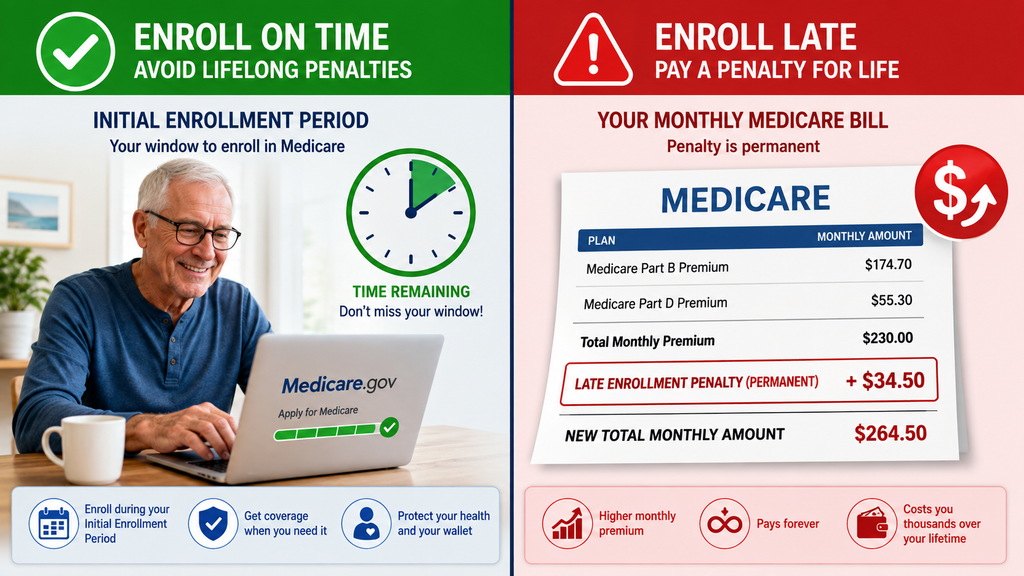
The trigger is the 63-day rule: the penalty applies if you go 63 or more continuous days after the end of your Part D Initial Enrollment Period without either Part D coverage or other creditable drug coverage.
A short gap won’t cost you, but a gap that reaches 63 days will.
This critical window catches many people off guard.
With Part D, you only have about the first two months, 63 days to be exact, after losing employer coverage to get Part D coverage without a penalty. Medicare requires you to avoid going more than 63 days without Part D or other creditable drug coverage after you enroll in Part A and/or Part B.
The good news? As long as you stay within that window, you remain protected.
What Counts as Creditable Prescription Drug Coverage?
You don’t need to enroll in a Part D plan specifically to avoid the penalty.
Medicare considers prescription drug coverage creditable when it expects the coverage to pay, on average, at least as much as the standard Part D plan. If you have creditable coverage, you can delay signing up for Part D without owing a late enrollment penalty.
Common sources of creditable prescription drug coverage for Medicare-eligible individuals include employer-sponsored plans, union plans, VA benefits, TRICARE, and certain retiree health plans.
COBRA continuation coverage counts only when the specific plan provides creditable drug coverage. Check the plan’s Notice of Creditable Coverage rather than assuming it qualifies.
Each year, the plan sponsor usually sends you a written Notice of Creditable Coverage before October 15. This notice tells you whether your prescription drug coverage qualifies as creditable coverage.
Save these notices.
They provide proof that you maintained qualifying coverage and never crossed the 63-day gap.
How the Part D Penalty Is Calculated
Here’s where the math matters because the numbers add up faster than most people expect.
The Part D late enrollment penalty is calculated by multiplying 1% times the “national base beneficiary premium” ($38.99 in 2026) times the number of full, uncovered months you were eligible to join Medicare drug coverage but didn’t and didn’t have other creditable prescription drug coverage.
That amount is rounded to the nearest $0.10 and added to a monthly premium. The national base beneficiary premium may go up each year, so a penalty amount may also increase each year.
Here’s a real-world example to put it in perspective:
Frank, age 70, became eligible for Medicare in May 2022 but didn’t enroll in a Part D prescription drug plan. He lacked other creditable prescription drug coverage and had no drug coverage until December 2025. This 43-month gap without creditable drug coverage triggered a Part D late enrollment penalty.
With the 2026 national base beneficiary premium at $38.99, Frank’s penalty came out to 43% of $38.99, approximately $16.76, rounded to $16.80 per month.
That’s over $200 every year. For life.
Why the Penalty Amount Can Change Year to Year
Even after a penalty is established, the exact dollar amount isn’t fixed.
Unlike some other penalties, this one is permanent and is recalculated every year based on the national base beneficiary premium.
So if the base premium rises, a penalty amount rises along with it even if the percentage stays the same.
Four Proven Ways to Avoid the Part D Permanent Surcharge
Avoiding this penalty is genuinely straightforward once you know the rules. Here are the most effective strategies.
Enroll during your Initial Enrollment Period.
You won’t pay any penalties if you sign up for Medicare Part D coverage during your Initial Enrollment Period (IEP). Your IEP starts 3 months before you turn 65 and ends 3 months after the month you turn 65.
Enrolling during this window is the cleanest way to stay penalty-free.
Maintain creditable coverage if you delay Part D. If you’re still working and your employer plan qualifies as creditable prescription drug coverage for Medicare, you can delay Part D without penalty. Just confirm the coverage status with your plan each year.
Act fast when coverage ends.
If you lose creditable coverage, enroll in Part D within 63 days to avoid the penalty.
Don’t wait to compare plans for months, get enrolled first, then fine-tune.
Keep your documentation.
When you join a new drug plan, you’ll need proof of your previous creditable prescription drug coverage to avoid a penalty.
When you later join a Part D plan, it may send a letter asking about prior coverage, and you must respond by the deadline with proof of continuous creditable coverage to avoid the penalty. The annual notices are how you show you never crossed the 63-day gap.
How to Appeal a Part D Penalty You Think Is Wrong
Sometimes errors happen. If you receive a penalty notice you believe is incorrect, you do have recourse.
The person must mail or fax a reconsideration form within 60 days from the date on the original letter stating that they had to pay a late enrollment penalty. Medicare’s contractor may accept a late reconsideration request if the person shows good cause for filing late.
Send any supporting documentation alongside the form, especially those Notices of Creditable Coverage you’ve been saving.
Frequently Asked Questions
Q: Does the Part D late enrollment penalty go away if you switch plans?
No.The Part D late enrollment penalty is added to your premium for as long as you have Medicare drug coverage, even if you switch plans.
The penalty follows the person, not the specific plan.
Q: What if you qualify for Extra Help with Medicare costs?
If you get Extra Help, you don’t have to pay the Part D late enrollment penalty.
Extra Help is a federal program that assists people with limited income and resources in paying for Medicare prescription drug coverage costs.
Q: Does the 63-day rule apply to VA drug coverage too?
Yes, VA drug benefits are considered creditable coverage. But if you ever lose your VA coverage, you have exactly 63 days to sign up for a new plan without facing a Medicare Part D late enrollment penalty.
Keeping documentation of VA coverage is just as important as any other source.
Take Action Before the Window Closes
The Medicare Part D late enrollment penalty rewards those who plan ahead and it costs those who don’t. The formula is clear, the 63-day rule is firm, and the surcharge is permanent. But the good news is that this is entirely avoidable with a bit of proactive attention.
Whether you’re turning 65, recently retired, or nearing the end of employer-sponsored coverage, now is the right time to review your prescription drug coverage options. Check that your current plan is creditable, mark your enrollment deadlines on the calendar, and hold onto every Notice of Creditable Coverage you receive. These small steps make a significant difference in long-term retirement costs.
Contact Aidan Neshite with The Perl Path today for guidance on your enrollment.