

Think of it like using a travel agent to book a flight. The airline pays the agent’s commission and you still pay the same ticket price. Medicare works the same way.
Medicare brokers are paid commission by the insurance carriers, and for Medicare Advantage plans, CMS controls what they’re allowed to receive as commission.
That means the payment structure is firmly in the government’s hands, not left to individual negotiation.
And here’s the part that really puts minds at ease:
plan prices are filed with the federal government and cannot be marked up or changed by an agent under any circumstances.
So the premium you see is the premium you pay full stop.
The health plan carrier pays commissions preapproved by the federal government for every plan sold, and the enrollee does not and should not pay any type or form of money to the agent of record.
If someone asks for a direct payment for Medicare enrollment help, that’s a serious warning sign.
CMS Regulated Agent Commissions: The Government Sets the Rules
The Medicare commission system isn’t a Wild West situation. Far from it.
CMS has finalized requirements that redefine “compensation” to set a clear, fixed amount that agents and brokers can be paid regardless of the plan the individual enrolls in, addressing loopholes that result in commissions above this amount that create anti-competitive and anti-consumer steering incentives.
These are CMS Fair Market Value (FMV) maximums carriers may pay less, but not more.
That ceiling matters. It’s specifically designed to protect you.
This compensation, commonly referred to as commissions, is currently limited to the fair market value (FMV) as defined each year by CMS.
CMS updates these figures annually, and requires organizations to maintain complete documentation demonstrating that broker compensation schedules are updated in accordance with CMS guidelines and that agents are paid appropriately.
The result? An agent who helps you enroll in a Medicare Advantage plan in your area earns roughly the same commission no matter which qualifying plan you choose.
That means an agent often does not earn more by recommending one Advantage plan over another in the same area.
Does the Medicare Plan Cost the Same Without a Broker?
Yes and this is a big myth worth busting.
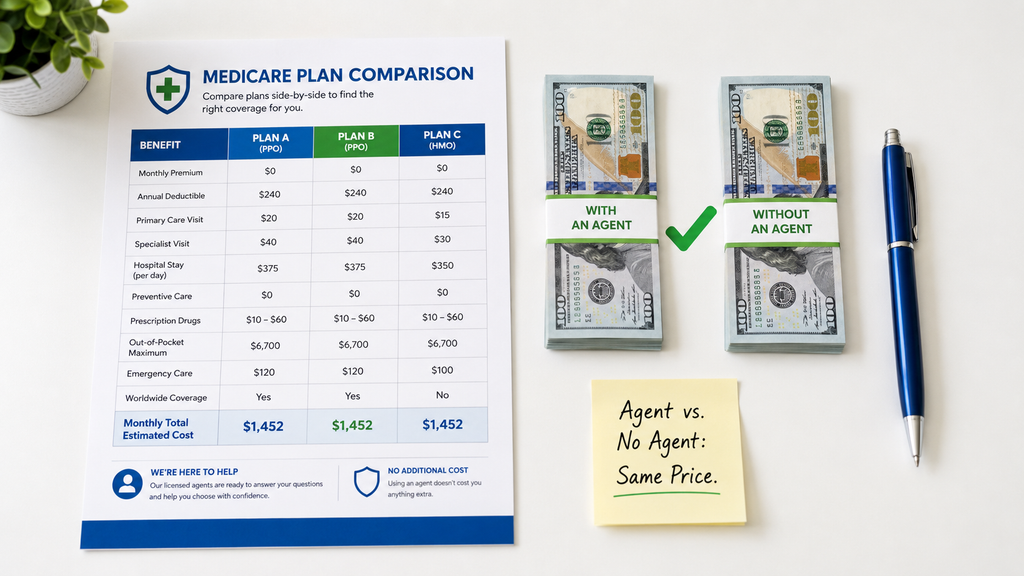
One of the biggest myths people hear is that it’s cheaper to “go direct” by calling an insurance company yourself. This isn’t true. Your monthly premium will be exactly the same whether you use an agent’s services or spend hours on hold with a carrier’s call center.
Using an agent simply means you get a personal guide for a price you’re already paying through your standard premiums.
The insurer has already built commission costs into its overall cost structure. Going without an agent doesn’t remove that cost, it just removes the guidance you could have had.
Brokers often earn a commission when they successfully set up a plan, and people do not pay anything for their services.
That’s a genuine win expert navigation of a complex system, at no additional cost to you.
Independent Medicare Agent vs Captive Agent: Why It Matters
Not all Medicare agents are the same and understanding the difference can have a real impact on the quality of your coverage.
Not all Medicare agents work the same way. There are two main types, and understanding the difference matters significantly for the quality of advice you receive. An independent broker is appointed with multiple insurance carriers, so they can compare plans across many companies and recommend the one that best fits your health needs and budget, regardless of which carrier pays the highest commission. Their loyalty is to you, not to any single insurance company.
A captive agent, on the other hand, works for a single insurance company and can only offer that company’s plans.
That’s a meaningful limitation.
If a carrier’s plans aren’t the best fit for your situation, a captive agent simply cannot recommend a competitor instead.
Think of it this way: a captive agent helps you choose from one shelf. An independent broker helps you compare several shelves.
In Medicare, that can be especially valuable because plan benefits, provider networks, drug formularies, and premiums can vary widely by county and by company.
The right plan for one person could be completely wrong for another even within the same zip code.
What an Agent Actually Does for You
Beyond saving you from hours of hold music, a good Medicare agent brings real, ongoing value.
Many individuals with Medicare rely on agents and brokers for assistance with navigating the complex Medicare choices as they comparison shop for coverage options.
That complexity is real. Medicare Advantage, Medigap, Part D drug plans each has its own rules, networks, and enrollment windows.
Plans often change their drug lists or doctor networks, and a good agent will help you make any necessary transitions smoothly, without hidden fees or enrollment charges.
Annual plan reviews are part of the service and they’re free.
Many people discover they’re paying for benefits they never use, or missing coverage they actually need. An independent broker can identify these gaps and recommend adjustments that better match your healthcare needs and financial situation.
FAQ
Q: Does Medicare agent cost extra compared to enrolling on my own?
A: No. The premium you pay remains the same regardless of where you purchase your coverage, and an agent’s commission does not change the cost or coverage of the plan.
You’re not paying more, you’re just getting expert support at no added charge.
Q: How are Medicare brokers paid by insurers?
A: Medicare brokers are compensated by insurance companies through commissions regulated by CMS.
The insurer pays the agent a set commission after you enroll; you never receive a bill for that service, and it doesn’t inflate your premium.
Q: Is an independent Medicare agent better than a captive agent?
A: It depends on your needs, but there’s a structural advantage to going independent.
Captive agents work for a single insurance company and can only sell that company’s plans, limiting clients’ options. Independent agents, by contrast, represent multiple insurance companies, giving clients a broader range of Medicare coverage options to choose from.
For most people who want a full market comparison, an independent agent is the stronger choice.
Get the Help, Keep Your Budget Intact
Does Medicare agent cost extra? No and now you know exactly why. The commission system is government-regulated, the plan price is fixed, and your agent gets paid by the insurer, not by you. It’s a setup that genuinely works in your favor.
The real cost of skipping an agent isn’t financial, it’s the risk of ending up in the wrong plan, with gaps in your coverage or a network that doesn’t include your doctors.
The difference between a plan that fits your health needs and budget and one that leaves you with unexpected costs often comes down to who helped you enroll.
So take the expert help. Ask an independent Medicare agent to walk through your options, your doctors, your prescriptions, your budget and find the plan that actually fits. You’ve got nothing to lose and potentially a lot of money and peace of mind to gain.
Ready to explore your Medicare options without spending a dime? Contact Aidan Neshite with The Perl Path today and see every plan available in your area.