

Medicare enrollment windows can feel rigid but they’re not as locked as they seem. Understanding Medicare special enrollment period qualifying events is the key that opens the door when life doesn’t follow the calendar.
A Medicare Special Enrollment Period (SEP) lets you enroll in or switch Medicare plans outside of standard enrollment windows when a qualifying life event occurs. The most common triggers are retiring after 65, losing employer coverage, moving, or changes in financial assistance programs. Timing is critical; most SEP windows last only 2 months, while the employer-coverage SEP gives you 8 months for Parts A and B. Don’t wait.
What Is a Medicare Special Enrollment Period?
A Medicare Special Enrollment Period (SEP) is a limited time outside the standard Medicare enrollment windows when you can enroll in or change plans due to specific qualifying life events, such as moving, losing creditable employer coverage, or qualifying for financial assistance like Extra Help.
Think of it like a permission slip. Normally, Medicare enrollment is confined to specific windows of your Initial Enrollment Period around your 65th birthday, or the Annual Election Period each fall. But life doesn’t always cooperate with those dates.
The most important feature of SEPs is the ability to make necessary coverage changes and, in some cases, avoid late enrollment penalties. Because SEP windows are often time-sensitive and tied to specific events, understanding your eligibility can help you avoid gaps in coverage and costly penalties.
Medicare SEP rules and qualifying events are updated annually by the Centers for Medicare & Medicaid Services (CMS), so it’s important to review the most current guidelines when making decisions.
The Most Common Medicare Special Enrollment Period Qualifying Events
Losing Employer Health Coverage or Retiring After 65
This is the big one and it’s the SEP most people need most urgently.
You can delay enrollment in Medicare Part A and/or Part B if you’re actively employed at a company with 20 or more employees on your 65th birthday, as long as you’re enrolled in active creditable health care coverage through your employer, union, or spouse’s employer.
Once you stop working or lose your health insurance, if that happens first you have an 8-month Special Enrollment Period when you can sign up for Medicare, or add Part B to existing Part A coverage.
That retiring-after-65 Medicare enrollment window is a genuine lifeline, but the clock starts ticking immediately.
Here’s an important nuance, though.
You will have up to 8 months to enroll in Parts A and/or B, but only the first two months to enroll in Parts C and/or D.
So the window isn’t the same across all parts. Act early, not just before the deadline.
There’s also a size rule most people miss.
The SEP has a size gate most people never hear about: the employer must have had 20 or more employees for the active-employment coverage to count as primary to Medicare. If you worked for a smaller employer past 65 and delayed Part B because your group plan was “good enough,” Medicare considers itself the primary payer for the years you were eligible and the penalty clock has been running since the month you turned 65, not the month you retired.
The COBRA Trap Know It Before It Catches You
This is where things get tricky.
The SEP starts when you stop working or lose insurance, even if you choose COBRA or other coverage that’s not Medicare.
COBRA and retiree coverage do not count as current-employer coverage, so they do not extend your 8-month Part B window. The clock starts when your active employment or employer coverage ends, not when COBRA ends. Enroll in Part B based on the job ending, even if you keep COBRA for other reasons.
Picture this scenario: someone retires, signs up for COBRA, and assumes Medicare can wait until COBRA runs out. Nearly 18 months later, they realize their 8-month SEP window has already closed.
Now there is no SEP, a General Enrollment Period wait, and a permanent Part B penalty.
That’s a costly mistake and a completely avoidable one.
Other Qualifying Events That Trigger a Medicare SEP
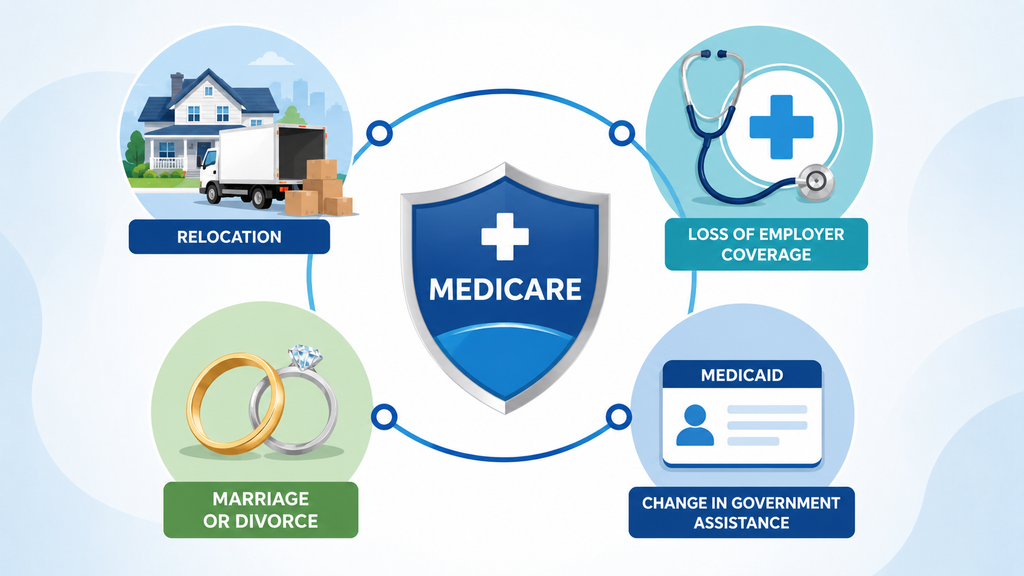
Losing employer coverage isn’t the only path to an SEP.
You may qualify for a 2-month Medicare Special Enrollment Period in the following situations: you move out of your plan’s service area; your plan closes, stops serving the area where you live, significantly reduces its provider network, or consistently receives low Medicare star ratings; you want to enroll in a 5-star plan at any time or drop your first Medicare Advantage plan within 12 months of enrolling; you move into or out of a qualified institutional facility like a nursing home; you are enrolled in or lose eligibility for a qualified State Pharmaceutical Assistance Program; or you have Medicare financial assistance such as Medicaid, a Medicare Savings Program, or Extra Help, or you gain or lose eligibility for any of these.
Losing Medicaid, being misinformed by an employer, leaving incarceration, or living through a declared disaster can each open a special “exceptional conditions” SEP.
Dual-Eligible Beneficiaries Get Extra Flexibility
If you qualify for both Medicare and Medicaid, the rules are more generous.
Having both Medicare and Medicaid allows you to join, switch, or disenroll from a Medicare Advantage or Part D plan up to one time per month this was previously a once-per-quarter opportunity but became monthly in 2025.
Switching Medicare Plans Outside Open Enrollment: What’s Actually Possible
People who already have Medicare may qualify for a 2-month Special Enrollment Period with certain qualifying life events. This SEP lets you switch to a different Medicare Advantage or Part D prescription drug plan.
So what can you actually change?
If you already have Original Medicare, you can change your Medicare Advantage or Medicare Part D plan within two months or more after a qualifying life event, depending on the type of event.
That’s meaningful flexibility for anyone whose coverage no longer fits their needs.
And if you’re enrolled in a Special Needs Plan (SNP)?
If you have a chronic, severe, or disabling medical condition and there’s a special needs plan available in your area for people with your medical condition, you can switch to that plan at any time.
How Long Does a Medicare SEP Last?
The answer depends on which qualifying event opened it.
For people who already have Medicare and experience a qualifying life event, there is a two-month Special Enrollment Period for switching a Medicare Advantage or Part D plan.
For people who qualified to delay Medicare because they had creditable coverage usually from an employer there is an 8-month Special Enrollment Period for enrolling in Medicare Parts A, B, C, and D.
But the window for Part D within that 8-month period is shorter.
When you lose your employer coverage, you only have 63 days to enroll in a Medicare Part D prescription drug plan or a Medicare Advantage plan that includes drug coverage.
Don’t let the 8-month window for Part B lull you into thinking Part D can wait just as long it can’t.
What Documentation You’ll Need
When you apply, you might need to submit documents that confirm your eligibility to enroll based on the life event you experienced.
When enrolling via SEP, Social Security requires proof that you had job-based coverage during the delay period.
Getting that documentation in order before you retire, not after is one of the smartest moves you can make.
Don’t rely on verbal confirmation from HR. Request a written letter on company letterhead stating that your coverage qualifies as current employment coverage under Medicare Secondary Payer rules. That letter protects you if a dispute arises later.
FAQ: Medicare Special Enrollment Periods
Q: Does COBRA coverage count toward my Medicare SEP eligibility?
No. COBRA and retiree health plans aren’t considered coverage based on current employment. If you have that type of coverage, you will not be eligible for an SEP when it ends.
The 8-month clock starts when your active employment or active employer coverage ends whichever comes first.
Q: What happens if I miss my Medicare SEP window?
Missing this window may mean waiting until the next Annual Enrollment Period and possibly facing late enrollment penalties.
For Part B specifically, this penalty is permanent and can add up to thousands over a lifetime. For example, delaying 3 years means a 30% surcharge on your Part B premium, an extra $60 or more per month, forever.
Q: Can my spouse’s employer coverage qualify me for a Medicare SEP?
Yes. If your spouse’s employer provides your coverage, the same rules apply based on the spouse’s employer size and employment status. Your SEP starts when the spouse stops working or the coverage ends, not when you turn 65.
Don’t Let the Clock Run Out
Medicare’s rules reward people who plan ahead and act quickly. The good news is that Medicare special enrollment period qualifying events genuinely give people a fair window to make the right coverage choices without penalty when life changes. The key is knowing that the clock starts when your event happens, not when you decide to pay attention to it.
Whether you’re approaching retirement, losing employer health coverage through Medicare, or navigating a move to a new area, your SEP is a valuable tool. Use it on time, document everything, and confirm the details directly with Medicare or a licensed insurance counselor. Coverage gaps and lifetime penalties are real but they’re also entirely preventable.
Ready to take the next step? Contact Aidan Neshite here at The Perl Path or call 702-503-8344 to confirm your specific SEP eligibility and enrollment options before your window closes.